

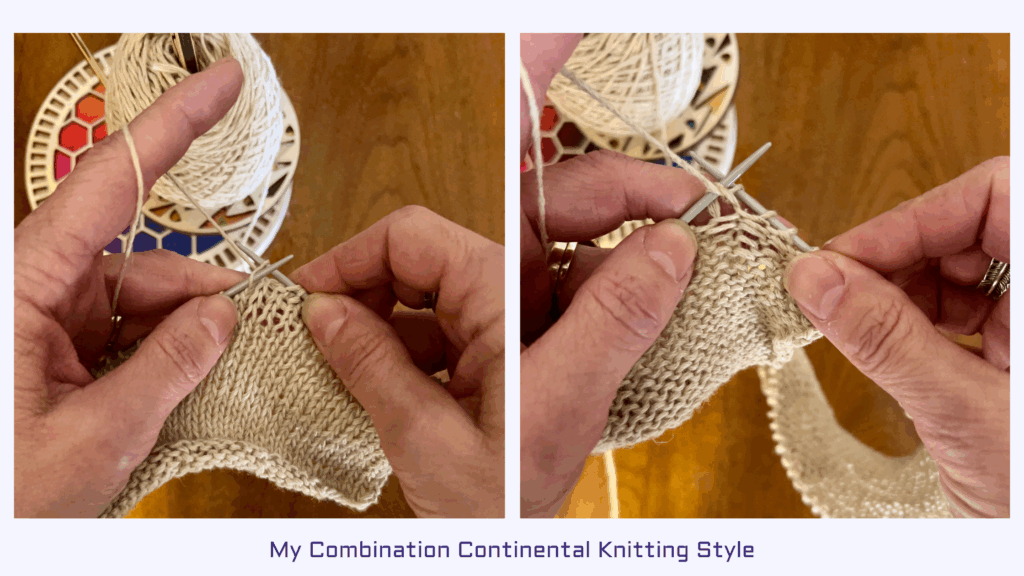
When people say “continental knitting,” they’re often talking as if it’s one single method. In practice, there are three distinct continental styles, each with its own movements, rhythm, and feel in the hands.
In my beginning knitting classes at The Yarny Way, I teach all three. Every knitter’s hands, history, and goals are different. Instead of asking students to adapt to one “right” way, I want them to discover the style that fits their body and their vibe.
Here are the three continental styles (Western, Eastern, and Combination) as explained by @Sorceress-Crafts on youtube

As a child she learning to knit combination continental from her Grandmother… and I too learned this method while spending time in Germany. I find it to be the easiest on your hands, and very even.
Take some time to try each style and come to a conclusion as to what you feel most comfortable with for your first project.
Let’s break them all down.
How it works
What it feels like
Why knitters love it
This is the most commonly taught continental style in the U.S. It’s efficient, intuitive, and plays well with colorwork and textured stitches. Many knitters start here and happily stay here.
Good fit if you…

How it works
What it feels like
Important note: This method often produces twisted stitches unless the pattern is written for Eastern mount stitches or you compensate on the following row. That isn’t a flaw—it’s simply a different system.
Why it matters
Many knitters around the world use this style naturally. Learning it helps you understand stitch orientation, pattern instructions, and why some fabric behaves the way it does.
Good fit if you…
How it works
What it feels like
Why knitters swear by it
Good fit if you…
Increasing and Decreasing using the Combination Continental Method Explained

Many classes teach one method and move on. I take a different approach.
In my beginner knitting class, students:
There is no gold star for knitting “correctly.” Comfort, clarity, and confidence matter more than tradition.
Some students pick one style and never look back. Others mix techniques depending on the project. Both are valid.
Knitting should feel supportive, not restrictive.
If you’re curious about how your hands want to knit, this exploration is a great place to start. Sometimes the biggest breakthrough isn’t learning a new stitch—it’s finding a movement that finally feels like yours.
