
Kingsgate South
8201 Quaker Ave. #149 Lubbock, TX 79424
806-416-YARN
Call or Text
Open Everyday 10-6
Closed Memorial Day

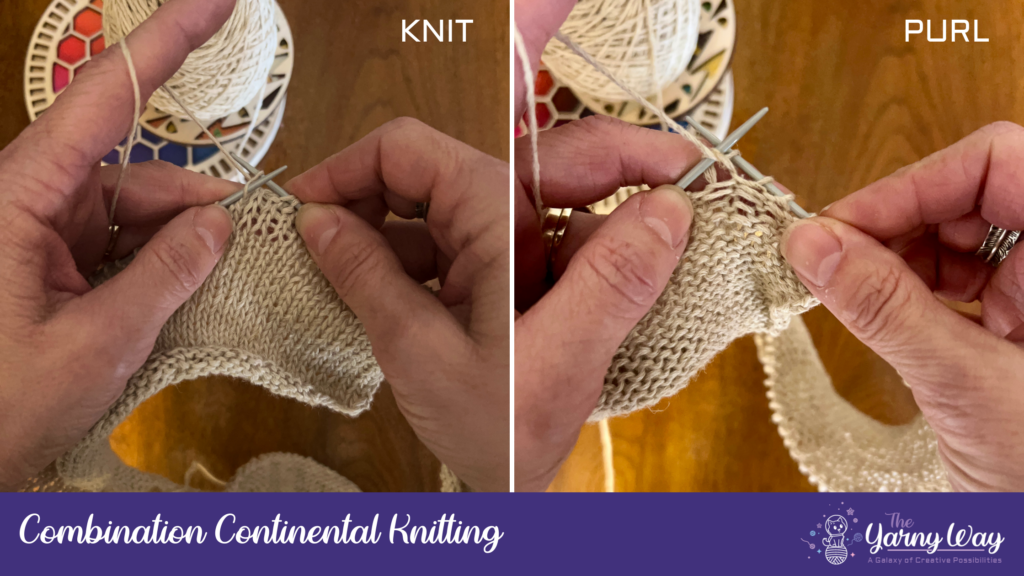
I’ve always known my knitting style was a little different. When I first learned to knit in Germany in the mid-’80s, I didn’t think much about it—I just knit the way I was taught. But as time went on, I started to notice that the techniques I saw in books and videos didn’t quite match up with what my hands naturally did. For years, I just made little adjustments so my stitches didn’t twist, thinking I had some oddball style. But now? Now I know that what I’ve been doing has a name: Continental Combination Knitting—and it’s not wrong. It’s just different. And that realization makes my knitting heart so happy!
Recently, I came across this incredible video that explains Continental Combination Knitting in detail, including how to adjust pattern instructions like SSK and K2tog to keep your fabric looking just right. It was a total lightbulb moment! So today, I want to share what I’ve learned and celebrate this beautiful, efficient, and oh-so-logical way of knitting. If you’re a fellow combination knitter (or just a curious stitch explorer), read on!

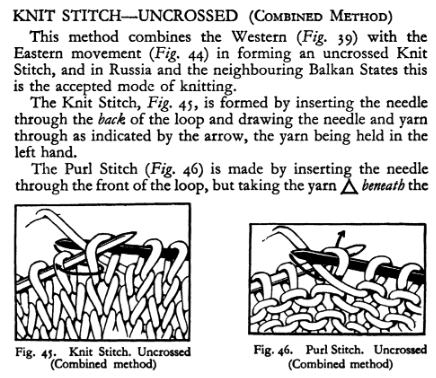
Combination knitting is like a secret handshake between two worlds—it blends elements from both Western and Eastern knitting traditions. Instead of following the standard Western stitch orientation (where the leading leg of the stitch sits in front of the needle), combination knitters often find their stitches mounted differently: with the leading leg at the back. This difference comes from how we wrap our yarn when purling, which naturally changes the stitch orientation for the next row. The result? A knitting style that’s not only efficient but can also produce beautifully even fabric.
The idea isn’t new. Mary Thomas wrote about combination knitting in Mary Thomas’s Knitting Book (1938), describing it as “the better way to work in Flat Knitting” (Thomas 56), noting its even tension and smooth results. But for those of us who’ve been knitting this way instinctively, it’s nice to know we’re part of a long tradition!
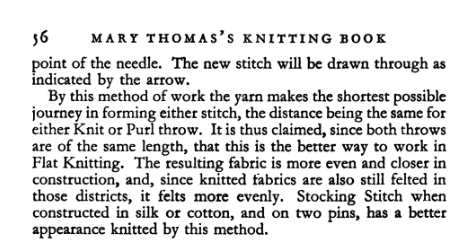
Works Cited Thomas, Mary. Mary Thomas’s Knitting Book. Hodder & Stoughton, 1938, p. 56.
If you’re new to this concept, let’s talk about stitch orientation. Every stitch on your needle has a front and a back leg. In Western knitting, the leading leg (the one closest to the tip of the needle) sits in front. In Eastern knitting, the leading leg sits in back. Combination knitting mixes the two—often, purl stitches will result in a leading leg that’s in the back, so on the next row, you may need to knit through the back loop to avoid twisting your stitches.
This little tweak makes a world of difference when following standard knitting instructions, particularly for decreases and increases. Which brings us to…
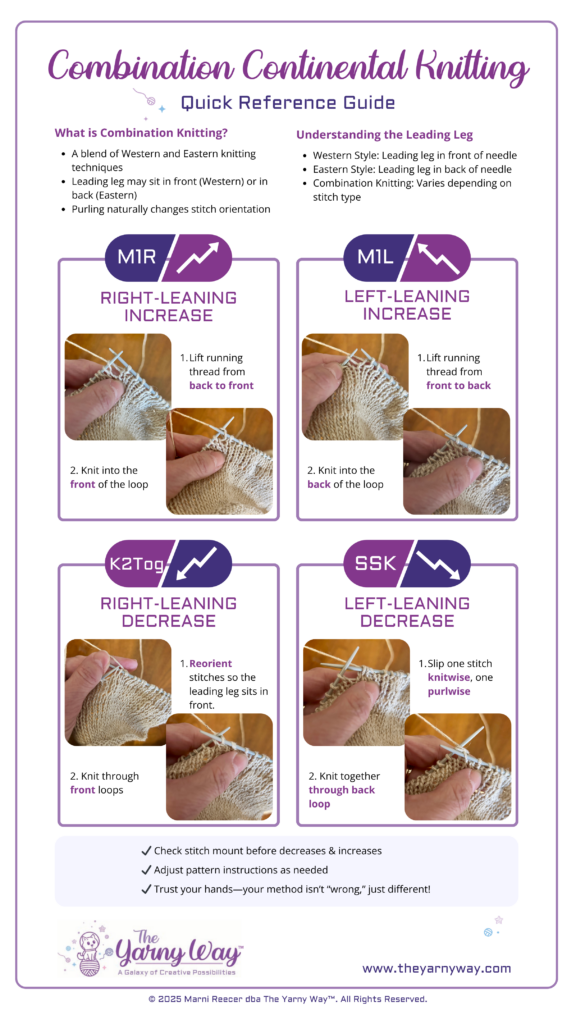
One of the most common stumbling blocks for combination knitters is how to work decreases like K2tog (knit two together) and SSK (slip, slip, knit) without accidentally changing the slant.
When it comes to increases, Make One Right (M1R) and Make One Left (M1L) can feel tricky at first, but once you understand how they work with your stitch orientation, it’s smooth sailing.
A helpful way to remember this:
Want to see it in action? Here’s a great video demonstrating combination continental knitting, with adjustments for pattern decreases and increases.
Source: The Chilly Dog. “7 Things Every Combination Knitter Should Know.” YouTube, 20 Feb. 2020, www.youtube.com/watch?v=6Vs0ToOPD_c.
Discovering that my knitting wasn’t wrong, just different, was such a freeing moment. For years, I worried that my technique wasn’t “right” because it didn’t match what I saw in English-language books and videos. But knitting is a deeply personal, creative craft—there are countless ways to move the yarn and needles, and they all lead to something beautiful.
So if you’re a combination knitter, embrace it! Adjust patterns when necessary, trust your instincts, and keep on knitting in a way that feels natural to you. Whether you’re knitting socks, shawls, or a cozy galaxy-themed sweater, your stitches are uniquely yours. And that’s what makes this fiber journey so magical. ✨
Are you a combination knitter too? Have you had an “aha!” moment about your knitting style? Share your thoughts in the comments—I’d love to hear your story!
Happy stitching,
Marni

Pick up a Yarn Trail Passport ($1), shop your favorite local yarn stores, collect stamps, and enjoy small thank-you gifts along the way.
4 Responses
hello, i wanted to clarify the k2tog and ssk.
just wanting to know for the k2tog in your explanation, are you knitting through the front or back leg?
(my how to) k2tog: change leading legs to front for both stitches, then knit both together through the front loops
and for the ssk why are you slipping knitwise and purlwise? and also is knitwise, like the front leg knitwise? otherwise it’s sort of useless to slip them and slip them back because it doesn’t reorientate? what twist or untwist are you trying to avoid?
(my how to) ssk: knit both together through back legs
i am fairly new to knitting, and i have found combined continental to be the easiest! the explanations for M1R and M1L make sense and i have those confidently now – just getting confused on all the slightly different ways to decrease
thank you 🙂
Hi! Great questions — and honestly, this confusion is very common when learning combination knitting because many tutorials assume Western-mounted stitches without saying so. Once you understand stitch orientation, the decreases start making much more sense.
For combination knitters, your approach is completely valid:
k2tog
Yes — if your stitches are Eastern-mounted (leading leg in back), you would first reorient them so the leading legs are in front, then knit 2 together through the front loops. That produces a standard right-leaning decrease without twisting.
If you simply knit through the front loops while the leading legs are still in back, the stitches twist.
For ssk, the reason many tutorials say:
* slip knitwise
* slip knitwise (or sometimes purlwise)
* knit through back loops
is because in Western knitting, those slipped stitches are being reoriented before working them together to create a left-leaning decrease.
But in combination knitting, your stitches may already be mounted differently. So yes — sometimes all that slipping becomes unnecessary motion.
If your stitch orientation is already set correctly, knitting the two stitches together through the back loops can absolutely function as your left-leaning decrease.
The important thing is not the exact motions. The important thing is:
* the direction the decrease leans
* whether the stitches twist
* and whether the finished fabric looks clean
A lot of combination knitters eventually stop memorizing “ssk” as a fixed movement and instead think:
“I need a left-leaning decrease without twisting.”
Then they choose the most efficient path based on how their stitches are mounted.
You’re actually asking exactly the right questions, because it means you’re starting to read stitch structure instead of just copying motions. That’s a big turning point in knitting.
I also thought my knitting was strange. I learned to knit from my mother who was born in Poland. My question is, does two-color Brioche knitting require any changes to how we have the stiches on the needle. It appears it does not affect the single color brioche stitch but it looks a little strange when knitting two color Brioche. Do you have any suggestions on how to handle the two color Brioche when knitting combination continental style?
Combination knitting is efficient because it reduces motion and can make purling faster, but brioche is one of those techniques where stitch orientation becomes extremely important all the time — not just occasionally. When every stitch is paired with a yarnover and you’re constantly working stacked stitches together, the mental overhead of tracking Eastern vs. Western mount can outweigh the ergonomic benefit.
Being able to switch styles based on the fabric or technique is a real strength, not a failure of consistency.
For two-color brioche specifically, Western mount often makes:
* stitch reading easier
* decreases more intuitive
* fixing mistakes less confusing
* following tutorials/patterns simpler
* brk/brp rhythm more automatic
And because brioche already asks your brain to think differently structurally, removing the extra “wait, which leg is leading?” step can make the whole experience much calmer.
A lot of experienced knitters end up with a hybrid philosophy:
* Combination for stockinette, ribbing, flat knitting, or purl-heavy fabrics
* Western for lace, brioche, complex decreases, or anything highly chart-dependent
That flexibility is actually advanced knitting knowledge.
It’s similar to how many crocheters naturally change hook grips depending on:
* speed
* ergonomics
* yarn texture
* stitch complexity
The goal is good fabric and sustainable movement, not loyalty to one technique.
And honestly, learning both styles deeply makes you much better at understanding stitch structure overall. You stop memorizing motions and start reading the fabric itself.